


What I Ask Every Anxious Client Before We Talk About Anxiety
By John Corbett, Psychologist
When someone comes to see me because they are feeling anxious, overwhelmed, or emotionally exhausted, many expect our first conversation to focus on stress.
They tell me about demanding jobs, financial pressures, relationship difficulties, family responsibilities, or uncertainty about the future.

These issues are important, and we discuss them.
But before we explore any of those topics, there is usually one question I ask first:
"How have you been sleeping?"
The answer is often more revealing than people expect.
Many clients arrive believing their anxiety is causing their sleep difficulties. While that is certainly possible, I have found that many overlook another important possibility:
Poor sleep may not simply be a symptom of anxiety.
It may be one of its causes.
The Overlooked Foundation of Mental Health
In today's world, sleep is often treated as optional.
People sacrifice it to meet deadlines, care for family members, respond to emails, travel, socialise, or simply fit more into an already busy day.
For many professionals, particularly those in demanding careers, sleeping less has become normalised.
Some even view it as a sign of commitment or productivity.
Yet from a psychological perspective, sleep is not a luxury.
It is one of the most important biological processes supporting emotional wellbeing, cognitive performance, and mental resilience.
Without adequate sleep, the brain struggles to function as it was designed to.
Why Sleep Matters More Than Most People Realise
One of the brain's most important functions during sleep is emotional regulation.
When we sleep well, we are better equipped to manage stress, maintain perspective, tolerate uncertainty, and respond calmly to challenges.
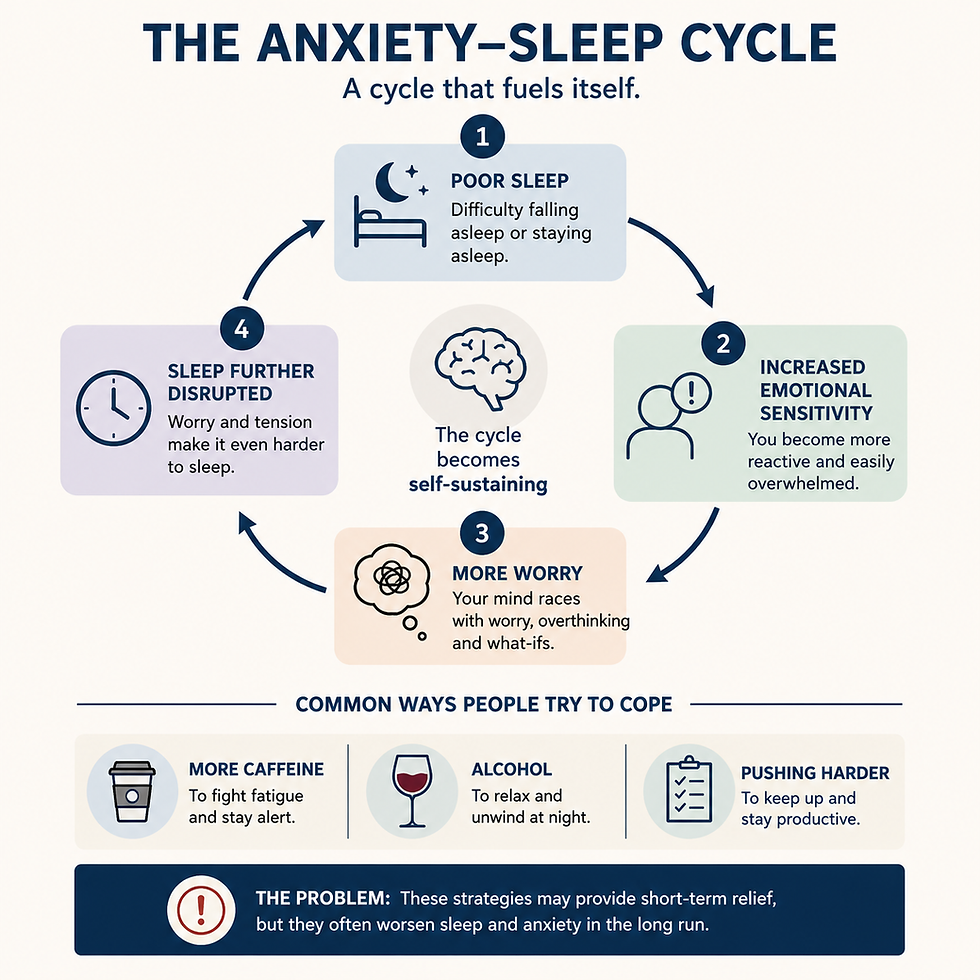
When sleep is disrupted, the opposite often occurs.
People become more emotionally reactive.
Small problems feel larger.
Decision-making becomes more difficult.
Patience decreases.
Worry increases.
Situations that would normally be manageable can suddenly feel overwhelming.
In clinical practice, I frequently see individuals who believe their anxiety has significantly worsened, only to discover that chronic sleep disruption is playing a major role.
The Professional Performance Trap
As both a psychologist and an Australian-trained lawyer, I have spent many years working with professionals in high-pressure environments.
One pattern appears repeatedly.
Successful individuals often assume they can function effectively despite poor sleep.
They continue working.
They attend meetings.
They meet deadlines.
They maintain responsibilities.
Because they remain productive, they conclude that sleep deprivation is not affecting them.
Unfortunately, the evidence suggests otherwise.
Research consistently demonstrates that insufficient sleep impairs concentration, memory, emotional regulation, judgement, and problem-solving ability.
Perhaps more concerning is that people who are sleep deprived often underestimate the extent of their impairment.
They may believe they are functioning normally when their performance, mood, and resilience have already been significantly affected.
The Anxiety-Sleep Cycle
The Hidden Impact Beyond Mental Health
The consequences of chronic poor sleep extend beyond anxiety.
Over time, sleep deprivation can affect relationships, work performance, physical health, and overall quality of life.
I often hear clients describe feeling increasingly irritable with their partner, less patient with their children, or more reactive to colleagues.
Others report difficulty concentrating, reduced motivation, and a growing sense of emotional exhaustion.
These changes rarely occur overnight.
They accumulate gradually, making them easy to overlook.
Many people attribute them to stress, workload, or ageing without considering the role sleep may be playing.
A Different Way to Think About Anxiety
When people experience anxiety, they often search for complex explanations.
Sometimes those explanations exist.
But sometimes the starting point is remarkably simple.
Sleep is not the entire answer to anxiety.
Nor is every anxiety disorder caused by poor sleep.
However, in many cases, improving sleep becomes one of the most effective interventions available.
It strengthens emotional resilience.
It improves cognitive functioning.
It enhances our ability to cope with stress.
And it provides the brain with the recovery it needs to function effectively.
This is why I continue to ask the same question at the beginning of so many consultations.
Before we explore work pressures.
Before we discuss relationships.
Before we analyse thoughts and behaviours.
I want to know:
How have you been sleeping?
Because in many cases, meaningful psychological recovery begins there.


Comments